
Boxing accessories
Last updated: May 1, 2026
How to choose the ideal punch bag wall bracket according to your space and wall type
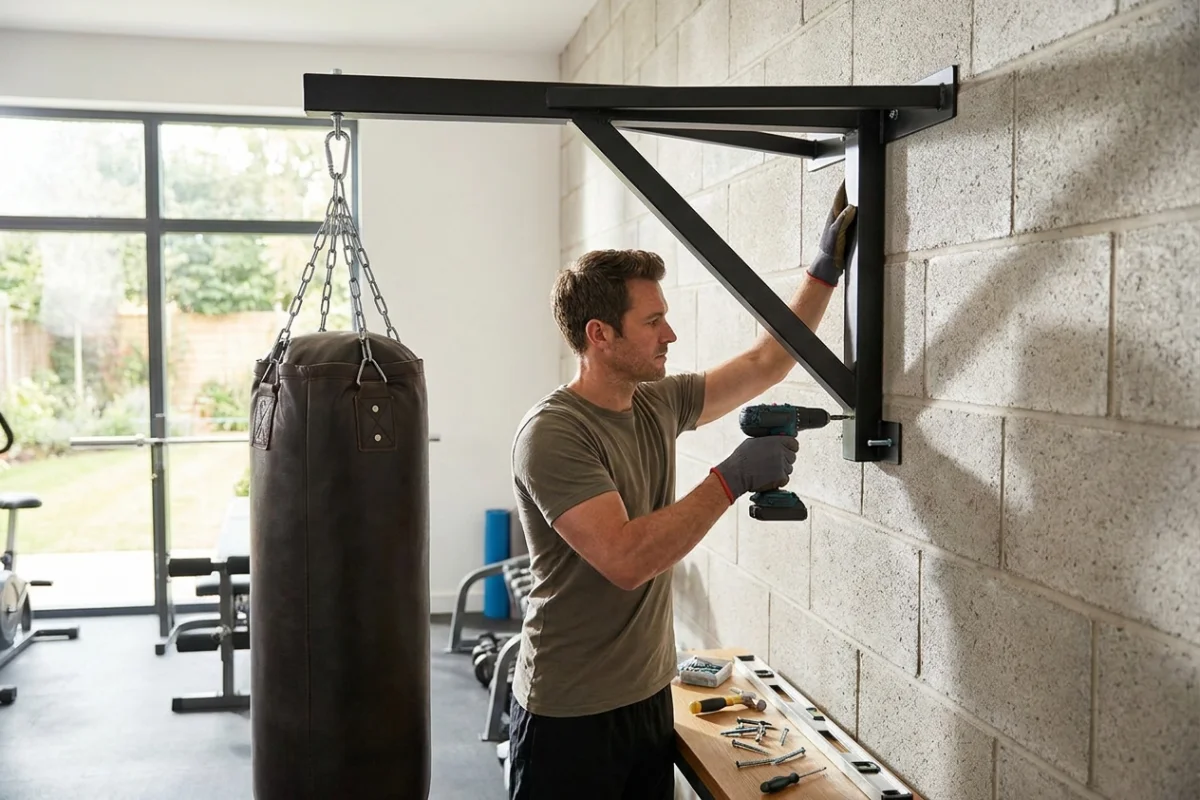
Installing a punch bag at home requires more than just having enough space; the safety of your training and the integrity of your home depend directly on a solid anchor. Choosing the right wall bracket is essential to avoid accidents and ensure that the bag withstands the constant impact of your most powerful strikes.
In this guide, you will discover how to choose the wall bracket for your punch bag by analyzing critical factors such as load capacity, wall material, and the extension arm. Not all brackets are the same, and a poor choice can lead to cracks in the structure or the equipment coming loose during use.
If you are looking for a solution that combines stability, durability, and safety, here you will find all the necessary technical information. You will learn to identify the different types of anchors and additional accessories that will help reduce vibrations and noise in your training area.
Common mistakes when choosing a wall mount for your punching bag
Installing a punching bag at home is one of the best decisions to improve your physical condition, but choosing the wrong wall mount can end in disaster. Many users make the mistake of buying the cheapest model without considering the actual weight of the bag or the strength of their wall. An inadequate mount can not only be damaged, but it can tear off pieces of the wall or cause accidents during training.
Among the most common failures is not checking if the wall is made of solid brick, concrete, or plasterboard. It is also common to ignore the length of the mount arm, which limits the movement of the bag and causes it to constantly hit the wall. Understanding these variables is essential to guarantee a safe and fluid practice in your own home gym.
Below, we analyze the key points so that your choice is the right one and your training equipment remains firm and secure for years.
Benefits of opting for a fixed wall mount
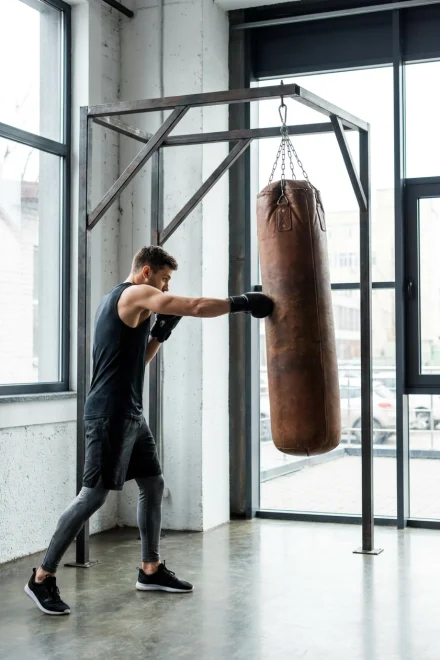
The use of a wall-anchored mount offers superior stability compared to floor stands. By being fixed directly to the structure of the home, the bag hardly moves from its axis, allowing you to work on striking power with total confidence. This firmness is vital for boxers looking to improve their punch without the equipment swinging excessively.
Another key benefit is space saving. Unlike boxing stations that take up a large part of the floor, the wall mount leaves the lower area clear. This facilitates cleaning and allows for other footwork or shadow boxing exercises under the bag when it is not in use. It is the ideal solution for garages or rooms with limited square footage.
Additionally, it allows for total height customization. By installing it yourself, you can place the bag exactly at your eye and shoulder level, optimizing technique. Reinforced steel models are designed to withstand constant vibrations, which guarantees extreme durability even with high-intensity daily training.
Risks of improper installation at home
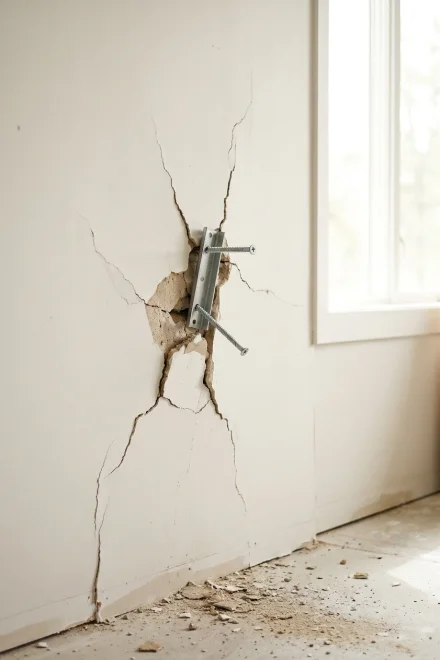
Installing a bag mount requires precision; otherwise, the structural risks are considerable. The main danger is the detachment of the anchor, which can occur if inadequate wall plugs are used or if the wall is too weak for the weight of the bag.
The constant vibrations can generate cracks in hollow brick or plasterboard partitions. If a mount with enough fixing points is not used, the force of the impact is concentrated in a small area, weakening the wall over time and causing annoying noises in the rest of the house.
There is also the risk of joint injuries if the mount is too short. If the bag is too close to the wall, the bounce is unpredictable and the user can hit the wall or strain their wrist when impacting at an incorrect angle.
Recommendation: always use metal expansion bolts, verify that the wall is load-bearing or structural, and use a shock-absorbing spring to reduce the impact of vibrations on the structure.
How to choose the mount according to your available space
Not all home gyms are the same. Depending on whether you have a dedicated room or a multifunctional corner, you should choose a type of mount that adapts to your movements and the architecture of your home.
🏗️ High-performance fixed mounts
They are the most robust and stable. Ideal for heavy bags over 50 kg and for users who strike with great power. They strictly require a concrete or solid brick wall.
🔄 Folding or swivel mounts
Perfect for shared spaces. They allow the bag to be folded against the wall when not in use, reclaiming the room's space. They are very practical in small apartments or garages.
📏 Long-arm mounts
They offer a greater distance from the wall (more than 70 cm), allowing you to move 360 degrees around the bag to work on footwork and dodging without obstacles.
🛡️ Mounts with diagonal reinforcement
They include crossbars that distribute weight more efficiently. They are the best option if you are concerned about the long-term integrity of the wall and seek to minimize torsion.
🔗 Mounts with speed platform
Hybrid models that include an arm for the heavy bag and an upper platform for the speed bag. Ideal for comprehensive coordination and power training in a single spot.
Evaluating the space and type of training is the first step. A fixed mount is for power purists, while a folding one is a lifesaver for those who train in the living room. Always choose with the safety of your structure in mind.
Tips for a professional installation at home
📏
Mark the drilling points using the mount as a template to ensure perfect alignment and leveling.
🧱
Never install the mount on plasterboard walls or thin partitions without internal structural reinforcement of wood or metal.
🔩
Use metal expansion bolts instead of plastic plugs to ensure that the weight and swinging do not overcome the anchor.
🛡️
Install a shock-absorbing spring between the mount and the bag chain to absorb vibrations and protect the wall from micro-cracks.
🔧
Check the tightness of the screws once a month, as constant hitting can slightly loosen them over time.
Types of wall mounts and their technical characteristics
Standard wall mount (Fixed)
It is the most common and reliable model. It consists of an L or T-shaped steel structure that is bolted directly to the wall. Its simple design minimizes failure points, making it extremely durable. It is the recommended option for those looking to train pure power without worrying about mount maintenance.
They usually have a load capacity of between 60 kg and 100 kg, depending on the thickness of the steel. Being fixed, it is crucial to choose the installation site well, as once placed, moving it will involve filling holes and drilling again in another structural area.
Folding wall mount
This ingenious design allows the arm holding the bag to swing to one side when not in use. It is the perfect solution for garages or multi-purpose rooms. Although they are very practical, you must ensure that the locking mechanism is robust to prevent the arm from moving laterally during striking.
Its load capacity is usually slightly lower than fixed models due to the moving parts, but high-end models are reinforced to support heavy bags without compromising user safety.
Reinforced mount for heavy bags (Heavy Duty)
Designed for professional gyms or heavyweight users, these mounts feature multiple anchor points (sometimes up to 6 or 8 screws) and larger section steel beams. They are capable of supporting bags over 100 kg and are prepared to absorb brutal impacts without yielding a single millimeter.
In summary, the choice depends on your level and space. A beginner with a light bag will have enough with a standard mount, while a professional or someone with little space should look at reinforced or folding options.
Technical comparison of wall mounts
| Mount type | Max load | Stability | Assembly difficulty | Ideal for | Approximate price |
|---|---|---|---|---|---|
| Fixed Standard | 60 - 80 kg | High | Medium | Regular home use | 25 € – 50 € |
| Folding | 50 - 70 kg | Medium-High | Medium | Small spaces | 40 € – 75 € |
| Heavy Duty | +100 kg | Maximum | High | Professionals and XL bags | 60 € – 120 € |
Frequently asked questions about how to choose the wall bracket for your punch bag
How much weight should a boxing wall bracket hold?
As a general rule, the bracket should be able to withstand at least twice the weight of your bag. If your bag weighs 40 kg, look for a bracket certified for 80 kg or more, as the force of the impact multiplies the actual load on the anchors.
Can I install a bag bracket on a plasterboard or partition wall?
It is not recommended. Plasterboard walls do not have the necessary density to support the weight and vibrations. Ideally, it should be installed on concrete, solid brick, or cement block walls to ensure a secure fixation and avoid structural damage.
How long should the bracket arm be?
The arm should allow the bag to hang at a minimum distance of 60 to 80 centimeters from the wall. This allows you to move around the bag and perform punch combinations without the equipment hitting the wall with every swing.
Is a fixed or folding bracket better?
The folding bracket is ideal for small spaces, as it allows you to tuck the bag against the wall when not in use. The fixed bracket is usually more robust and offers superior stability for high-intensity training with very heavy bags.
What type of screws or anchors should I use?
Always use metal expansion bolts (also known as metal anchors). Avoid conventional plastic wall plugs, as the constant vibration from hitting will eventually loosen them and compromise the safety of the installation.
How can I reduce noise and vibrations at home?
Installing a shock-absorbing spring between the bracket and the bag chain is the best solution. This accessory absorbs much of the impact energy, reducing the noise transmitted through the house structure and extending the life of the bracket.
At what height should I place the wall bracket?
The height depends on your stature and the length of the bag. The goal is for the main impact zone of the bag to be at eye level. Make sure to leave enough space for the chains and the attachment carabiner.
What maintenance does a wall bracket require?
Check monthly that the anchor bolts have not loosened and that there are no visible cracks in the wall around the bracket. It is also recommended to lubricate the pivot point or the carabiner to avoid annoying squeaks.
Is a bracket with multiple anchor points necessary?
Yes, the more anchor points the base plate has (minimum 4 or 6), the better the load and tension will be distributed over the wall. This reduces the risk of the bracket prying and damaging the construction material.
What material is the most resistant for these brackets?
Heavy-gauge steel with powder coating is the quality standard. Steel ensures the arm doesn't bend over time, while the coating protects against corrosion if the gym is in a garage or damp area.