Boxing accessories
Last updated: April 27, 2026
How to choose the ideal boxing reflex ball to improve your precision and coordination
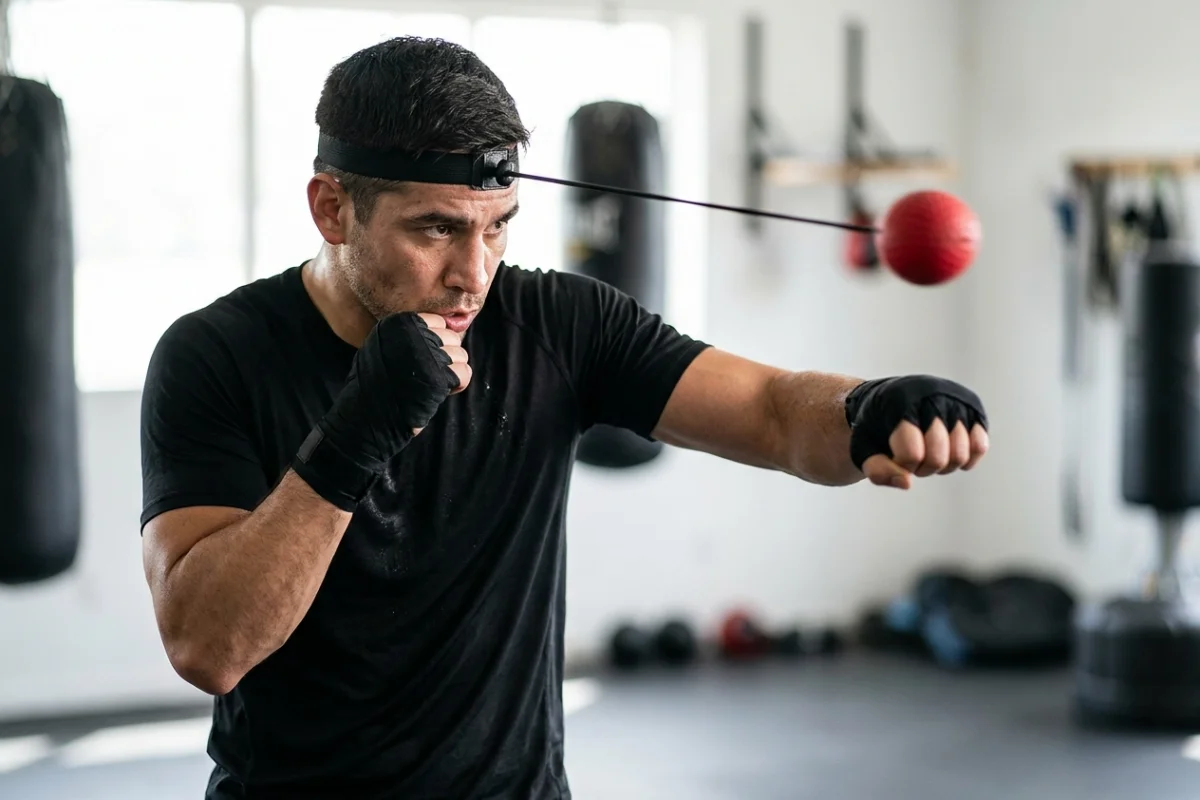
The boxing reflex ball, also known as a reflex ball or headband ball, has become an essential accessory for boxers of all levels. Unlike heavy bags, this equipment focuses on hand-eye coordination, precision, and reaction speed, allowing you to train anywhere.
Choosing the right model depends on your experience and the specific goals you seek to achieve. Factors such as the ball's weight, the elasticity of the cord, and the type of attachment are decisive in avoiding frustration and maximizing the performance of your training sessions.
In this guide, you will learn how to choose the ideal boxing reflex ball for your level. We will analyze the different materials, from soft foams for beginners to dense rubbers for professionals, and give you the best tips to integrate this accessory into your daily routine safely and effectively.
What is a boxing reflex ball and how does it help your training?
The boxing reflex ball, also known as a reflex ball or headband ball, is a simple yet extremely effective training tool. It consists of a ball attached to an elastic string that is fastened to the head, allowing the athlete to hit the ball and have it return in an unpredictable way.
Unlike heavy bags, its goal is not to develop brute strength, but to perfect hand-eye coordination, reaction speed, and punching accuracy. By training with it, you force your brain to process fast visual information and execute precise movements in fractions of a second.
There are different types of balls depending on their weight and elasticity, which determines the return speed and the difficulty of the exercise. Choosing the right one is essential to avoid initial frustration and ensure constant progress in your combat skills or simply in your general physical condition.
In short, it is a portable, affordable, and highly effective accessory that can be used by both professional boxers and fitness enthusiasts looking to improve their mental and physical agility from anywhere.
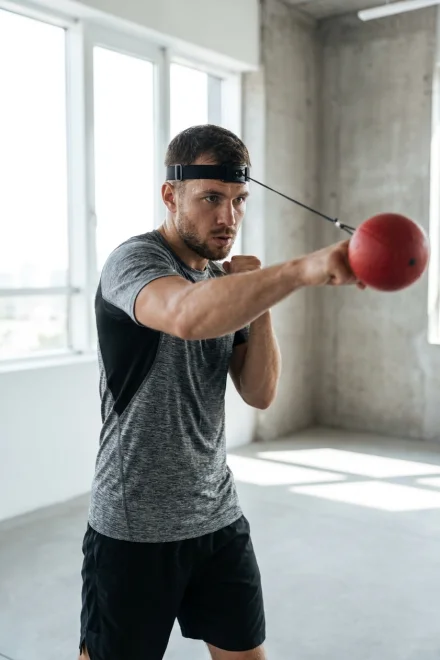
Advantages of training with a reflex ball
Training with a reflex ball offers benefits that go beyond traditional boxing. It is one of the best ways to work on timing and concentration under pressure, simulating the speed of a real opponent responding to your attacks.
One of the main advantages is the drastic improvement in punching accuracy. Being a small and constantly moving target, the margin for error is minimal, forcing you to keep your eyes fixed on the target and constantly adjust your fists. This translates into greater effectiveness during sparring or real combat.
Additionally, it is an excellent cardiovascular exercise that improves shoulder endurance. Keeping your hands up in guard and repeatedly hitting the ball requires sustained muscular effort that strengthens the deltoids and improves arm mobility.
- Develops superior hand-eye coordination.
- Improves reaction speed and defensive reflexes.
- Increases concentration and mental focus.
- It is a fun and dynamic cardiovascular workout.
- Allows training in small spaces and is easy to transport.
Ultimately, the reflex ball is a versatile and complete tool that helps build the technical foundation necessary for any contact sport.
Different types of balls according to level
Not all reflex balls are the same. The material and weight are the factors that determine how fast the ball will return toward your face. For beginners, soft foam balls are recommended. They are lightweight, have a slower bounce, and, most importantly, do not hurt if they hit you by mistake.
For intermediate or advanced level users, rubber balls are the best option. These are heavier and denser, which generates a much faster and more aggressive bounce. They require more refined technique and considerable hand speed to maintain the rhythm without losing control.
- Foam balls: Ideal for learning basic technique.
- Rubber balls: To improve punching speed and power.
- Adjustable elastic cords: Allow for varying the difficulty of the exercise.
- Multi-ball systems: Kits that include several weights to progress.
Choosing the right kit will allow you to gradually evolve, moving from slow and controlled movements to bursts of fast punches that will test your limits.
The importance of a good headband and fastening
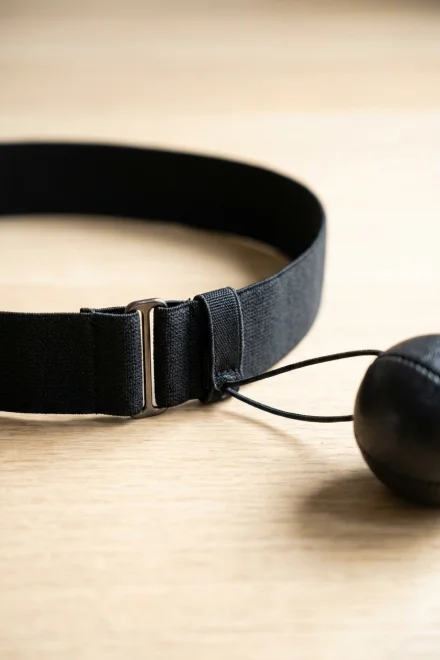
A common mistake when choosing a reflex ball is not paying attention to the headband or fastening strap. If the strap slips with sweat or does not fit correctly, training will become frustrating and the ball will not bounce consistently.
The best headbands are made of breathable and non-slip materials, such as high-quality nylon or silicone. A good fit ensures that the anchor point of the elastic remains fixed in the center of your forehead, which is vital for the ball's trajectory to be predictable and for you to establish a punching rhythm.
- Adjustable Velcro closure for different head sizes.
- Sweat-wicking materials to prevent it from falling into the eyes.
- Metal or reinforced plastic anchors for greater durability.
- Ergonomic design that does not cause chafing during prolonged use.
Investing in a model with a comfortable and firm fastening will make the difference between a productive training session and a constant interruption to readjust the equipment.
Possible disadvantages and how to avoid them
Although it is an excellent tool, the reflex ball has a learning curve that can discourage some. At first, it is normal to miss most of the punches or for the ball to hit you in the face. Therefore, it is crucial to start with very light and soft balls.
Another limitation is that it does not replace training with a bag or mitts to gain power. Its focus is purely technical and reflex-based. Additionally, if the elastic is of poor quality, it can break after a few uses, so it is always advisable to check the cord's resistance before buying.
- Initial frustration due to coordination difficulty.
- Risk of small impacts on the face (use soft balls).
- Does not develop punching power.
- Requires maintenance of the elastic to avoid breakage.
To minimize these drawbacks, the ideal is to practice in front of a mirror at first to correct posture and better understand the bounce trajectory.
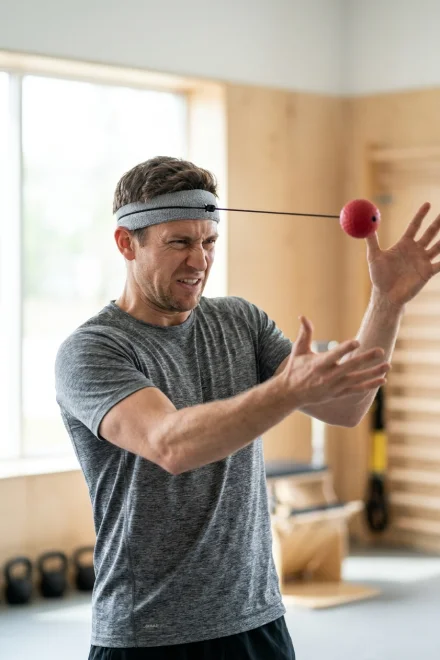
Conclusion: Is it worth buying a reflex ball?
After analyzing its benefits and features, the answer is a resounding yes. The boxing reflex ball is one of the best value-for-money investments you can make for your personal training equipment. Whether you are a professional or a beginner, the benefits in coordination and agility are notable in just a few weeks.
The key to choosing the ideal one lies in looking for a balance between the quality of the headband and the variety of balls included in the kit. Starting with a light ball will allow you to build the necessary muscle memory before moving on to faster and more challenging models.
Finally, remember that consistency is the most important thing. Dedicating just 10 or 15 minutes a day as part of your warm-up or cool-down will make a big difference in your peripheral vision and hand speed. It is a fun challenge that will keep your mind sharp and your body moving.
Which reflex ball to choose according to your profile
Depending on your previous experience in contact sports and your personal goals, you should opt for one type of setup or another. Here is a quick guide to help you decide which model best suits your current needs.
🥊 Absolute beginners
If you have never boxed, choose a kit that includes a very light foam ball (soft red or yellow color). The elastic should be long to give you more reaction time. The goal here is simply to touch the ball rhythmically.
⚡ Intermediate users
For those who already have some coordination, the ideal is a medium-weight ball. This allows for increasing the intensity of the training and starting to incorporate head movements and lateral shifts while punching.
🔥 Professionals and experts
Advanced athletes should opt for heavy rubber balls with high-tension elastics. This generates an ultra-fast return that forces defensive reflexes to work at the highest level of demand.
🧒 Children and youth
For the little ones, safety comes first. Only fabric or soft foam balls should be used to avoid any eye damage and encourage the development of psychomotricity in a playful way.
🏃 Fitness Enthusiasts
If your goal is to burn calories, look for a kit with several interchangeable balls. Alternating between light and heavy weights will create an interval workout that will keep your heart rate high.
Whatever your level, make sure the elastic is adjustable so that the ball is at chest height when at rest; that is the standard measurement for an effective workout.
How to start training correctly
Once you have your reflex ball, the first step is to adjust the length of the elastic. A rule of thumb is that the cord should be the same length as your extended arm. If it is too long, it will lose rhythm; if it is too short, it will be too fast to start.
1. The first contact: Do not try to hit hard. Start with soft downward taps, as if you were dribbling a basketball but with your fists. This will help you understand how the ball bounces.
2. Find the rhythm: Once you master the downward tap, try to hit the ball forward. Do not look for speed, look for consistency. Try to land 10 consecutive hits without the ball touching your body or stopping.
3. Incorporate the guard: As you gain confidence, always keep the non-punching hand near your face. This is not only good boxing practice, but it will also protect you if the ball returns in an unexpected trajectory.
- Keep your shoulders relaxed to avoid premature fatigue.
- Do not take your eyes off the ball at any time.
- Exhale with each punch to maintain a constant breathing rhythm.
- Practice in short sessions of 3 to 5 minutes to avoid visual fatigue.
With patience and daily practice, you will see how what initially seemed impossible becomes a fluid and natural movement.
Practical tips for using your reflex ball
📏
Adjust the elastic to your arm length for optimal control of the initial bounce.
👓
If you wear glasses, consider using contact lenses or very soft foam balls to avoid accidents.
🧘
Maintain a relaxed posture; excessive tension in the neck will hinder your natural reflexes.
🔄
Change the elastic every 2 or 3 months if you train daily, as they lose their elasticity and consistency.
🛡️
Always use boxing hand wraps if you use the heavier rubber balls to protect your knuckles.
Final summary: Your path to better accuracy
Choosing the ideal boxing reflex ball is the first step to transforming your agility and coordination. By prioritizing safe materials and a stable fastening system, you ensure that your focus is where it should be: on improving every day.
Remember that this tool is complementary. For best results, combine it with other shadowboxing, bag, and technique exercises. The reflex ball will give you that competitive edge in visual processing speed that few other accessories can offer.
Whether you are looking to be the next boxing champion or just want a fun and challenging workout at home, the reflex ball is a smart choice. Put it on, adjust the elastic, and start hitting!
Frequently asked questions about how to choose a boxing reflex ball
What exactly is a boxing reflex ball?
It is a training accessory consisting of a ball attached to an elastic headband by a cord. The goal is to hit the ball continuously as it bounces, which improves reflexes, rhythm, and punching precision.
Is it suitable for boxing beginners?
Yes, it is excellent for beginners. It is recommended to start with soft foam balls, as they are lighter, bounce slower, and do not cause pain if they accidentally hit the face while basic technique is being developed.
How do I know if the cord is the correct length?
The ideal standard measurement is for the cord to be the length of your arm (from the shoulder to the closed fist). If you are advanced, you can shorten it slightly to increase the bounce speed and the difficulty of the exercise.
What materials are most recommended?
To start, polyurethane foam is ideal for its safety. Advanced boxers usually prefer dense rubber or caoutchouc balls, which offer a much faster bounce and require a higher reaction speed.
What real benefits does it bring to training?
It drastically improves hand-eye coordination, timing, peripheral vision, and the ability to maintain concentration under fatigue. Additionally, it helps perfect defense by forcing you to move your head after punching.
Do I need to use gloves to train with it?
It is not strictly necessary, but it is recommended to use boxing wraps or light bag gloves. This protects the knuckles from constant friction with the cord and the ball's surface, especially if it is made of rubber.
How to prevent the ball from hitting my eyes?
The key is to start with soft, controlled punches downwards. As you gain rhythm, you can punch forward. Using soft foam balls at the beginning minimizes any risk of annoying impact.
What is the difference between a light and a heavy ball?
Light balls (foam) are easier to control and more predictable. Heavier balls have more inertia, require firmer punches, and return with much more force, better simulating the rhythm of a real exchange.
Can the difficulty of the exercise be adjusted?
Yes, you can increase the difficulty by shortening the elastic cord, using a smaller and heavier ball, or incorporating lateral movements and footwork while punching.
Is it a good cardiovascular exercise?
Although it seems like a technical exercise, maintaining the rhythm for several 3-minute rounds generates a high cardiovascular demand and improves shoulder endurance due to the constant volume of punches.