Punching bags
Last updated: May 25, 2026
How to choose the ideal wall boxing bag to improve your striking technique
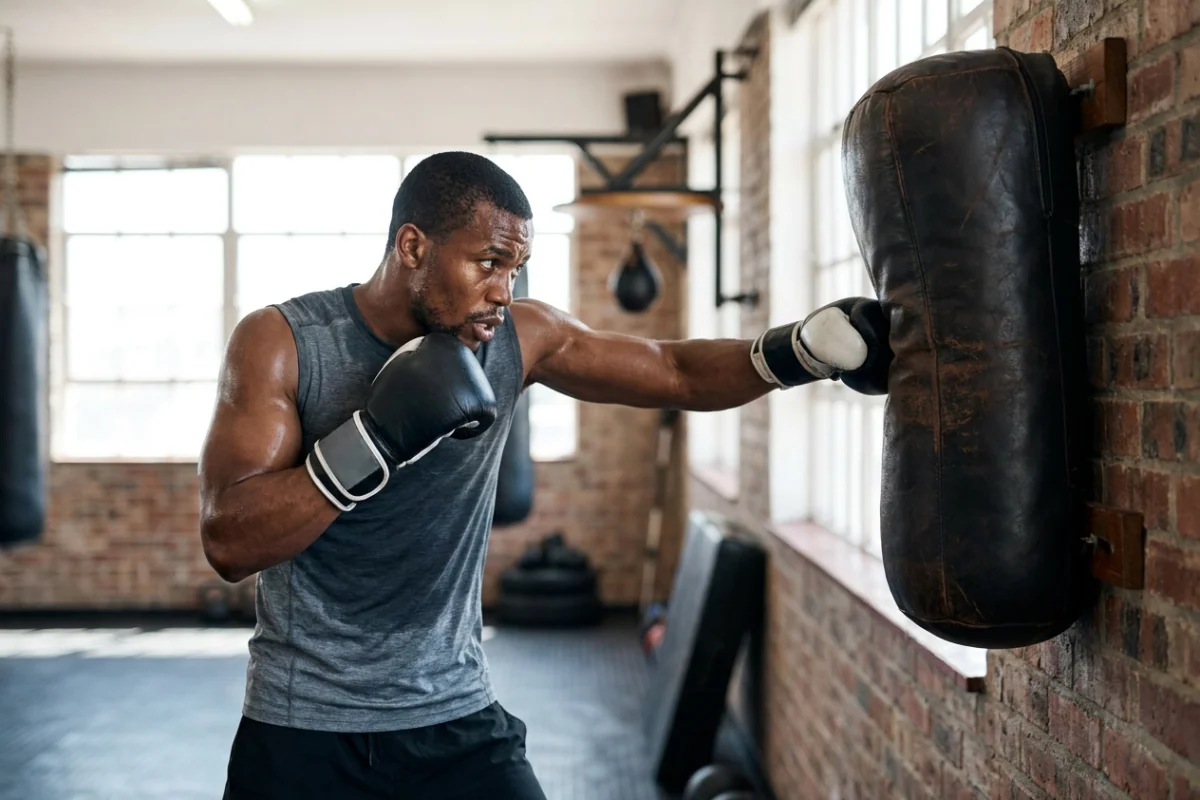
The wall boxing bag, also known as an uppercut wall pad, is a specialized tool that is often underestimated, but is vital for perfecting angled strikes. Unlike traditional heavy bags that hang from the ceiling, this equipment is fixed directly to the wall structure, offering a stable surface with contours designed for upward striking.
In this guide, you will learn how to choose the ideal wall boxing bag according to your level, available space, and training goals. We will analyze everything from padding density to anchoring systems, determining factors to ensure safe and effective practice of your hooks, crosses, and uppercuts.
If you are looking to optimize your short-range technique and do not have space for a hanging bag, the wall pad is the ultimate solution. Here you will find all the information necessary to identify a model of high durability and ergonomics that transforms your home gym or training center.
Why choose a wall-mounted punching bag for training?
The wall-mounted punching bag, also known as a wall bag, is a fundamental tool for boxers looking to perfect their striking technique in confined spaces. Unlike traditional hanging bags, these are fixed directly to a solid structure, offering a stable impact surface specific to certain striking angles.
Wall bags are primarily designed to work on precision and power in short strikes such as the uppercut, hook, and jab. Since they do not swing, they allow the fighter to maintain a constant distance and focus exclusively on movement mechanics and knuckle placement.
Traditional heavy bags, on the other hand, require a ceiling mount or a standing structure and tend to swing after each impact. While this is excellent for working on footwork and timing, the wall bag offers immediate resistance that is superior for strengthening wrists and improving explosiveness at short distances.
In summary, the wall bag is a compact, technical, and highly efficient option for those who do not have much space or want a specialized complement to improve the trajectory of their curved strikes.
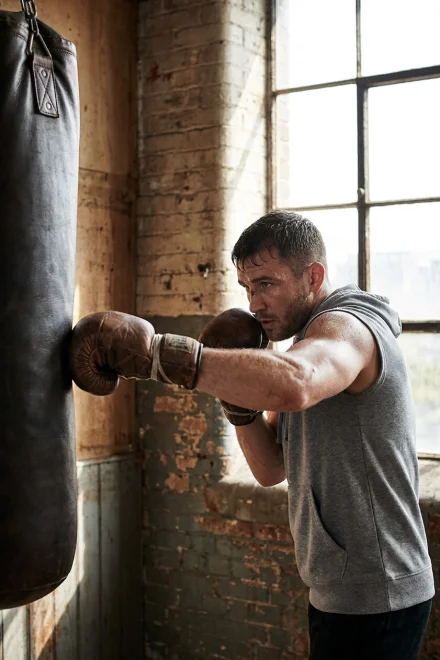
Advantages of training with a wall bag
Using a wall-mounted punching bag provides specific benefits that are difficult to achieve with other gym equipment. Its ergonomic design, often with different angles of inclination, allows for a more realistic simulation of the opponent's anatomy for certain strikes.
One of its greatest advantages is space optimization. By being anchored directly to the wall, it leaves the entire floor surface free, making it ideal for garages, small rooms, or high-traffic commercial gyms. Additionally, being a fixed structure, chain vibration noise is completely eliminated.
It also allows for working on pure power without interruptions. By not having to wait for the bag to return from its swing, the athlete can chain high-intensity combinations with a much higher frequency, improving the anaerobic endurance of the shoulders.
- Ideal for perfecting uppercuts and hooks.
- Maximum space saving in the training area.
- Greater stability for working on impact power.
- Allows for more fluid combination training.
- Less material wear as there are no moving hardware parts.
Ultimately, it is a smart investment for any combat sports practitioner who wants to take their precision and punching power to the next level without space complications.
Limitations and installation considerations
Although the wall bag is extremely useful, it has limitations that you should know before buying it. The main one is that its position is fixed, which prevents working on circular footwork or lateral slips that a suspended bag allows.
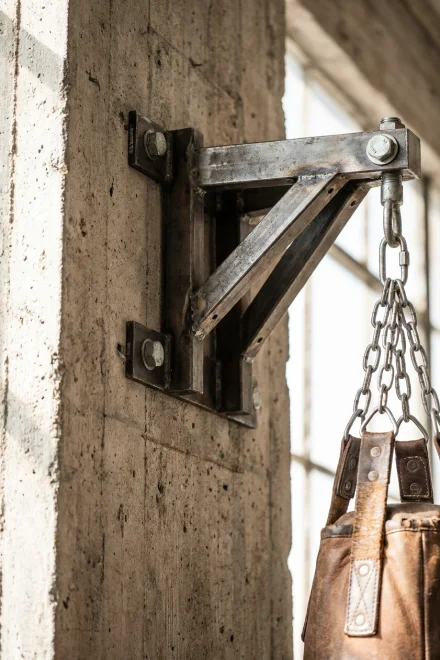
Installation is a critical point. It requires a load-bearing wall or a solid concrete wall; installing it on drywall or hollow brick partitions without proper reinforcement can cause serious structural damage. Additionally, by absorbing the impact directly against the wall, vibrations can be transmitted to other rooms in the house.
- Does not allow for 360-degree movement work.
- Requires a very strong wall and high-quality anchors.
- Height is not easily adjustable once installed.
- Transmission of vibrations through the building structure.
- Limited striking surface compared to a long bag.
Therefore, it is vital to plan the mounting location well and ensure that the placement height is correct for your stature, as once fixed, moving it will involve making new drill holes.
How to choose the wall bag according to your profile
Not all wall bags are the same. Depending on whether you practice traditional boxing, Muay Thai, or MMA, you will need a model with specific characteristics of hardness, shape, and size. A correct choice will prevent hand injuries and maximize your technical progress.
Below, we show you which type of wall bag best suits each need so that your choice is as accurate as possible.
🥊 Technique Boxers (Uppercut Bags)
If your focus is classic boxing, look for bags with multiple angles and protrusions. These models allow for striking from the bottom up naturally, protecting your wrists when executing powerful hooks and uppercuts.
🥋 MMA and Muay Thai Practitioners
For these disciplines, a wall bag with a longer and flatter surface at the bottom is preferable. This allows for integrating elbow strikes and, in some reinforced models, even working on the precision of front knees.
🏠 Home Users (Small Spaces)
If you train at home, opt for models with improved impact absorption systems. Some bags include gel layers or high-density foams that reduce noise and vibration reaching neighbors.
💪 Power Training (Heavy Duty)
For heavy hitters, the outer material should be genuine leather or high-resistance vinyl. These bags withstand abrasion better and maintain their original shape despite receiving constant heavy-duty impacts.
Remember that, regardless of the model, the use of proper wraps and gloves is mandatory. The wall bag is more rigid than a hanging one, so protecting your joints is essential.
Keys for optimal maintenance and use
🔧
Check the screws and anchors monthly; constant vibration can loosen them and compromise safety.
🧼
Clean the surface with a damp cloth after each session to remove sweat and prevent the material from cracking.
📏
Install the center of the bag at chin height so that direct and curved strikes have a realistic trajectory.
🧤
Always use bag or training gloves; hitting a wall bag with bare hands guarantees bone injuries.
🧱
If vibration is excessive, place a dense rubber sheet between the bag support and the wall to muffle the sound.
Conclusion: Is the wall bag the best investment?
Choosing a wall-mounted punching bag is an excellent decision if you are looking to improve the technique of your curved strikes and maximize the use of your training space. Its stability and specialized design make it a professional-level tool that perfectly complements any combat routine.
It is ideal for boxers living in apartments or who have a limited area, as long as they have a solid wall for anchoring. Although it does not completely replace the heavy bag in terms of mobility, its ability to develop power and precision at short distances is unmatched.
Before deciding, evaluate your wall material and the type of strikes you most want to perfect. With proper maintenance and a secure installation, a wall bag will accompany you for years in your evolution as a fighter. It's time to hit harder and more accurately than ever!
Frequently asked questions about how to choose the wall boxing bag
What exactly is a wall boxing bag?
It is a padded training equipment that is fixed to a wall or column. Its design is usually angled or contoured, allowing for the practice of strikes that a conventional cylindrical bag does not facilitate, such as the uppercut or the hook to the chin.
What advantages does it offer compared to a traditional heavy bag?
The main advantage is stability; by not swinging, it allows for working on fast and precise combinations. Additionally, its ergonomic design is optimized for upward strikes and takes up much less space, making it ideal for places with low ceilings.
At what height should a wall bag be installed?
The ideal height is one where the central section of the bag is at your chin height. This allows strikes directed at the head and body to be executed with realistic and biomechanically correct mechanics.
What materials are most recommended?
For intensive use, genuine leather is the best option for its durability. However, high-quality synthetic leather (PU or microfiber) is an excellent and more affordable alternative that offers very similar resistance to sweat and constant impacts.
Is it very noisy to install in a flat or apartment?
Since it is anchored directly to the structure, vibrations can be transmitted through the wall. It is recommended to install it on load-bearing walls or solid walls and, if possible, use rubber insulators between the bracket and the wall to reduce acoustic impact.
What type of filling should a good wall pad have?
It should have high-density foam or gel layers. A filling that is too soft will deform quickly, while one that is too hard could injure your wrists. The key is that it absorbs the impact and recovers its original shape immediately.
Can I use it to train other disciplines like MMA or Muay Thai?
Yes, it is excellent for working on elbows and knee strikes at close range. Its firmness helps condition the joints and improve the precision of power strikes in contact sports.
What maintenance does this equipment require?
It is minimal but important. You should wipe off sweat after each session with a damp cloth and periodically check that the anchor bolts remain firm to avoid accidents or damage to the wall.
Do I need special gloves for the wall bag?
You can use your regular training gloves, but due to the firmness of the wall bag, many professionals prefer bag gloves with denser padding to better protect the knuckles.
Is it difficult to install by yourself?
It requires basic tools like a hammer drill and expansion anchors. It is essential to ensure a solid fixation, as the bag will receive constant high-power impacts that could loosen a poor installation.