Boxing accessories
Last updated: April 2, 2026
How to choose the ideal boxing jump rope to improve your coordination and cardio

Jumping rope is one of the fundamental pillars in any boxer's preparation. It's not just a cardio exercise; it's the key tool for developing footwork, hand-eye coordination, and the explosive endurance needed to withstand rounds in the ring.
In this guide, you will learn how to choose the ideal boxing jump rope based on your experience level and specific goals. We will analyze everything from speed ropes for experts to weighted jump ropes for those looking to boost their strength and muscular power.
If you want to improve your agility and master the rhythm of the fight, choosing the right equipment is the first step. Here you will find the technical criteria, materials, and practical tips to make your jump training as efficient and safe as possible.
How to choose the ideal boxing jump rope to improve your coordination and cardio
The boxing jump rope is a fundamental tool in the training of any boxer, but also for any athlete looking to improve their cardiovascular endurance and agility. Jumping rope not only burns calories on a massive scale, but it also develops hand-eye coordination and footwork, critical elements for moving fluidly in the ring or in any sports discipline.
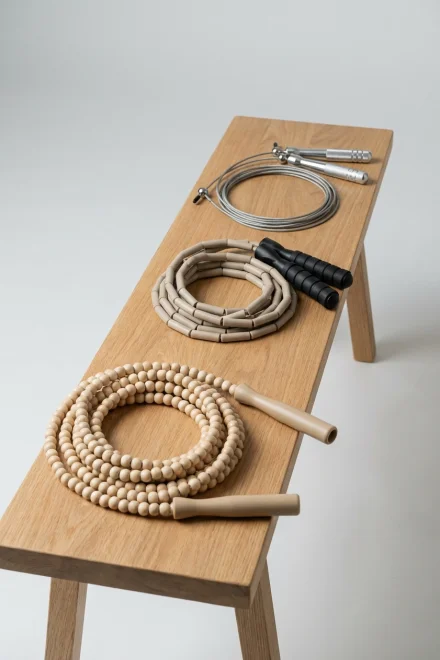
There are different types of jump ropes, from classic leather ones to modern coated steel cable ones. PVC or plastic ones are the most common for beginners due to their balance between weight and speed, while thin cable ones are specifically designed to reach high revolutions and facilitate advanced exercises such as double unders.
Beyond the material, the key to a good jump rope lies in its bearings. A fluid rotation system prevents the cable from tangling and allows for a constant rhythm, which is vital when seeking to enter the 'flow state' during training. Additionally, the ability to adjust the length is indispensable for adapting the tool to your exact height.
It is important to remember that, although it may seem like a simple exercise, choosing the wrong jump rope can lead to frustration or poor technique. A rope that is too long will make it difficult to turn, while one that is too short will cause constant tripping. Therefore, understanding the differences between the available models is the first step to mastering this discipline.
In conclusion: investing in a jump rope suited to your level and goals will transform your cardio sessions, allowing you to work on power, speed, and endurance simultaneously and effectively.
Benefits of weighted jump ropes
Weighted jump ropes are those that incorporate additional weight, either in the handles or in the cable itself. Unlike speed ropes, their main objective is not extreme speed, but the development of strength and muscular endurance in the upper body, especially in the shoulders, forearms, and back.
Using a heavy jump rope provides greater sensory feedback. By clearly feeling the movement of the rope, the athlete can better coordinate the jump, which makes them surprisingly useful for beginners who have difficulty keeping up with the rhythm of a light rope.
Training with extra weight significantly increases metabolic intensity. This means the heart must work harder to pump blood to fatigued muscles, turning a jumping session into a much more demanding full-body workout than conventional jumping.
It is essential to alternate the use of these ropes with lighter models so as not to overload the joints. Excessive weight without proper technique could lead to discomfort in the wrists or shoulders if a proper warm-up is not performed.
In summary, weighted jump ropes are the perfect choice if you are looking to tone your arms while improving your lung capacity, offering an additional challenge to your boxing or fitness routine.
Quick comparison: Speed or weight?
Choosing between a speed jump rope and a weighted one depends entirely on your personal goals. Both are excellent, but they work different physical capacities that you should know before deciding.
Regarding technique, speed ropes require very fine and fast wrist movement, ideal for those who already master the basic jump. Weighted ropes, for their part, require greater involvement of the entire arm, which helps novices 'understand' the rotation of the rope thanks to its inertia.
If we talk about boxing goals, the speed rope is king for improving footwork and explosiveness. However, the heavy rope better simulates the fatigue a boxer feels in the shoulders during the final rounds of a fight, improving specific endurance.
Regarding intensity, the heavy rope wins in fat burning per minute, but the speed rope allows for longer and more varied workouts, including tricks, crosses, and rhythm changes that keep the mind focused.
Ultimately, the ideal for a complete athlete is to have both models. Use the speed one for agility and technique days, and the weighted one for power and muscular endurance sessions.
Tips for choosing and using your jump rope
📏
To measure the ideal length, step on the rope with one foot and pull the handles upward; they should reach the height of your armpits.
👟
Always jump with athletic footwear with good cushioning to protect your joints from constant impact.
🧱
Avoid jumping on abrasive surfaces like concrete; use a mat or rubber floor to prolong the life of the cable.
🔄
Look for jump ropes with 360-degree ball bearings to ensure a smooth, tangle-free rotation.
🖐️
Choose handles with a non-slip grip; sweat can cause you to lose control of the rope in the middle of a round.
🧘
Keep your shoulders relaxed and elbows close to your body; the movement should come from the wrists, not the arms.
🔝
If you are a beginner, start with a 5mm PVC jump rope; it is heavy enough to feel and light enough not to tire you out.
✂️
If your rope is made of steel cable, use quality wire cutters to adjust it; do not try to do it with ordinary scissors.
⏱️
Train in intervals (e.g., 3 minutes of jumping, 1 minute of rest) to simulate the rhythm of a real boxing match.
🦶
Jump on the balls of your feet; your heels should barely touch the ground to maximize reactivity.
🛡️
If you use a thin cable rope, be careful when failing; the impact on your shins or back can be quite annoying.
🎒
Store your jump rope loosely coiled, without tight knots, to prevent the cable from getting kinks or strange shapes.
🔥
Use the jump rope as a dynamic warm-up; 5-10 minutes will activate your entire nervous and muscular system.
📈
Don't obsess over double unders at the beginning; master the basic jump and the boxer step first.
Which jump rope to choose according to your level and goal
Not all jump ropes serve the same purpose, and your choice should be aligned with your previous experience. A common mistake is buying an ultra-fast competition rope when you haven't mastered the basic jump yet, which usually ends in frustration due to constant tripping.
For beginners, the ideal is a medium-thickness PVC jump rope. These ropes have enough 'memory' to maintain the arc shape and are slow enough to allow you to learn the correct 'timing' between the jump and the turn.
Intermediate users who are already looking for speed and starting with double unders should move to 2.5mm to 3mm coated steel cables. These offer the perfect balance: they are fast but still transmit enough information to the hands to not lose control.
Finally, experts or competitors usually prefer cables of 1.5mm or less, with almost no coating. They are precision tools designed for maximum efficiency, where every gram counts to break speed records or perform complex tricks.
In summary, analyze where you are today and what you want to achieve tomorrow. A jump rope suited to your level is the best investment to ensure constant progression without injuries.
How to correctly adjust your new jump rope?
Adjusting the length is probably the most ignored and yet the most important step. A jump rope with an incorrect measurement will ruin your technique, forcing you to open your arms too wide or jump higher than necessary, which causes unnecessary fatigue.
Most modern jump ropes come with a system of adjustable screws or clips. To find your measurement, step on the center of the rope with one foot and bring the handles toward your chest. For a standard level, the end of the handle (where it joins the cable) should be at the height of your armpits.
As you gain experience, you will notice that you prefer the rope a bit shorter. Advanced jumpers usually bring it to the height of the sternum or even lower, as this allows them to keep their arms closer to the body and turn their wrists with greater speed.
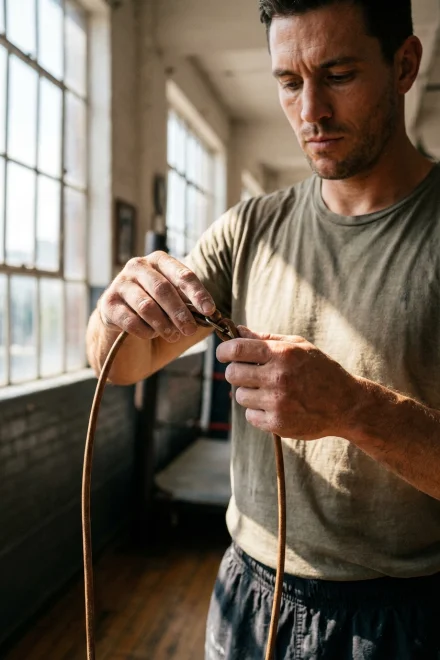
Once you find your measurement, cut the excess cable with pliers, but always leave a margin of 2 or 3 centimeters in case you decide to readjust it in the future. Don't forget to place the rubber caps on the ends to prevent the steel cable from fraying or scratching you.
Remember: a well-adjusted jump rope is an extension of your arms. Take the time necessary to calibrate it and you will notice the difference from the first jump.
Safety and technique to avoid injuries
Jumping rope is a low-impact per jump, but high-repetition exercise. This means that, although it is not as aggressive as running, the accumulation of thousands of jumps can take its toll if basic safety guidelines are not followed.
The golden rule is not to jump too high. You only need to rise a couple of centimeters, just enough for the rope to pass underneath. Keeping your knees slightly bent will act as a natural spring, absorbing the impact and protecting your lower back.
Pay attention to the surface. Jumping on hard tiles or concrete increases the risk of suffering from plantar fasciitis or shin splints. If you don't have access to a gym floor, a thin yoga mat or a piece of carpet can make a difference in your joint health.
Do not neglect the warm-up of wrists and ankles. Perform gentle rotations before starting and stretch your calves when finished. If you feel a sharp pain in the shin area, stop immediately; it is the body's warning sign before a possible stress injury.
In conclusion, correct technique not only makes you look more professional but also ensures that you can continue training consistently for years. Listen to your body and always prioritize the quality of movement over the quantity of jumps.
Conclusion: Which is the best jump rope for you?
There is no universal 'best jump rope', but rather an ideal jump rope for each moment of your sporting evolution. Whether you are looking for lightning speed to improve your boxer reflexes, or you prefer the physical challenge of a heavy rope, the important thing is consistency.
A good jump rope is one of the fitness tools with the best value for money on the market. For very little money, you have access to elite training that you can do anywhere, from a park to your living room.
Choose wisely, adjust with precision and, above all, enjoy the learning process. See you in the next round!
Frequently asked questions about how to choose the perfect boxing jump rope
How can I know what the correct length for my jump rope is?
To measure it, step on the center of the rope with one foot and pull the handles upward. The ends of the handles (where the rope attaches) should reach armpit height. If you are a beginner, you can leave it a couple of centimeters longer to avoid tripping.
What material is most recommended for a beginner boxer?
The PVC or vinyl jump rope is the best option to start. They have a medium thickness that allows you to better feel the rotation of the rope, which facilitates learning rhythm and coordination before moving on to thinner and faster cables.
What is the difference between a speed rope and a conventional jump rope?
The speed rope uses a very thin nylon-coated steel cable and high-speed bearings. It is designed for performing double or triple unders and improving speed, while the conventional one is more versatile for general conditioning.
Are leather jump ropes recommended for boxing?
Leather jump ropes are an 'old school' boxing classic. They are durable and have a balanced weight, but they are slower than PVC or steel ones. They are excellent for working on shoulder endurance, although they require more maintenance.
When should I use a weighted jump rope or weights in the handles?
Weighted jump ropes are ideal when you are looking to increase the intensity of cardiovascular training and strengthen the shoulders and forearms. They are not recommended for working on pure speed, but rather for power and muscular endurance sessions.
What type of bearings should a good boxing jump rope have?
Look for jump ropes with stainless steel ball bearings in the handles. These allow for a smooth, multi-directional, and tangle-free rotation, which is crucial for maintaining a constant rhythm and preventing the rope from slowing down during exercise.
Is it better to jump on hard or soft surfaces?
Avoid asphalt or concrete, as they damage the cable and increase the impact on your joints. Ideally, jump on gym flooring (rubber), wood, or a specific mat to protect your knees and extend the life of the jump rope.
How does cable thickness influence training?
A thick cable (4-5mm) offers more air resistance and is easier to control. A thin cable (2-2.5mm) is aerodynamic and allows for extreme speed, ideal for advanced boxers looking to improve their reflexes and foot speed.
How should I store my jump rope so it doesn't get deformed?
Never fold it tightly. It is best to coil it in a wide circular shape or hang it from a hook. If the cable is steel and is bent sharply, a permanent mark may remain that will affect the smoothness of the rotation.
How often should the jump rope cable be changed?
You should check it monthly. If you notice that the plastic coating has worn off and the steel is exposed, or if the PVC shows cracks, it is time to replace it to avoid accidental breakage during training.